Theory and Practice in Social System Mapping: Part 3 of an Interview with Glenda Eoyang
How a Social System Map Expands Consciousness and Increases Choice.
Details

How a Social System Map Expands Consciousness and Increases Choice.
DetailsExploring network consciousness with Glenda Eoyang of the Human Systems Dynamics Institute
Details“. . . a network map captures and represents those three fundamental characteristics (or CDE) that we think define the nature of all self-organizing systems. CDE means Container, Differences and Exchanges.” ~ Glenda Eoyang
DetailsA map without conversations is nothing and conversations without some form of mapping are much more fragmented.
DetailsHow you can simplify map access for your network members by turning sumApp into your Kumu map portal
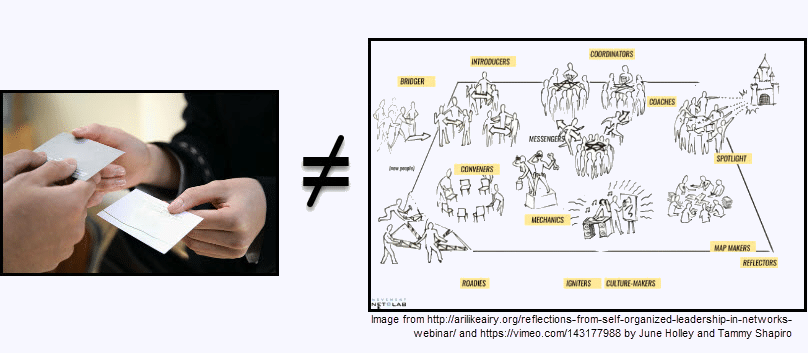
DetailsFor those of us who don’t resonate to Harvey McKay’s ‘Swim With the Sharks’ and that ilk – the default, mainstream meaning of ‘networking’ can be a big turn-off . We’ve come to understand it as a specific, often self-serving, not-necessarily-authentic, social butterflying kind of activity.
DetailsThe Maya Townsend interview has generated interest in live-link mapping – as well as questions about how to do it and what one should know. This post is in response to those questions.
Details. . . one of the [important] pieces… is to get that sense of ‘we’re not in this alone,’ that ‘we have more connections than we know.’
DetailsStorytelling is very important to inspire participation. However, it is especially the boundary spanning across communities – stories that capture the essence of an activity or an interaction in a community. ~ Aldo de Moor
Details“Maps have power. They always have throughout human history. Maps have been very powerful artifacts” – Aldo de Moor
Details